
Power outages are no longer rare events, especially in urban areas where electricity demand keeps rising year after year. For people living in apartments or city homes, even a short blackout can disrupt internet access, work-from-home setups, refrigeration, lighting, and basic daily comfort.
Unlike rural homes, urban residents face unique challenges when choosing a backup power solution. Noise restrictions, limited space, safety regulations, and building rules often rule out traditional generators altogether. This leaves many people confused between options like portable power stations, UPS systems, and solar backup kits.
In this guide, we compare the three most common backup power solutions available in 2026 and explain which one actually makes sense for urban homes. Rather than promoting a single product, this article focuses on helping you understand the strengths, limitations, and real-world use cases of each option—so you can choose the right solution based on how you live, not marketing claims.
The Real Problem with Backup Power in Urban Homes
Choosing backup power for an urban home is fundamentally different from choosing backup power for a standalone house. Apartments and city residences come with constraints that many backup systems simply do not account for.
Noise is the first issue. Gas generators are often prohibited due to noise pollution and safety risks. Space is another major limitation—there is rarely room for bulky equipment or permanent installations. Ventilation, fuel storage, and exhaust are also serious concerns in enclosed buildings.
Beyond physical limitations, urban power outages are often unpredictable. They may last one hour or several hours, making it difficult to justify complex or oversized solutions. This is why understanding actual power needs during an outage is critical before choosing any system.
Most mistakes happen when people select backup power based on product popularity rather than their real usage scenario.
Quick Overview — Three Common Backup Power Options
Before comparing details, it’s important to clearly understand the three most common backup power solutions people consider during power outages.
Each option is designed for a specific purpose, and problems arise when a system is used outside of its intended role.
What Is a Portable Power Station?
A portable power station is a rechargeable battery-based system designed to provide electricity without fuel, noise, or emissions. These units typically include multiple output ports for household devices and can be used safely indoors.
For urban homes and apartments, portable power stations have become increasingly popular because they require no installation, produce no fumes, and operate silently. They are often used to power essential devices such as routers, laptops, lights, fans, and small appliances during outages.
What Is a UPS System
A UPS (Uninterruptible Power Supply) is primarily designed to protect electronics from sudden power loss. It provides short-term backup power to allow devices like computers or routers to shut down safely or remain online briefly.
UPS systems are not designed to power household appliances or provide extended electricity. Their strength lies in data protection—not full backup power coverage.
What Is a Solar Backup Kit
Solar backup kits combine batteries with solar panels to generate and store electricity. While powerful in theory, these systems require adequate outdoor space, sunlight access, and often professional installation.
For many apartment dwellers, solar backup solutions are either impractical or restricted by building regulations, making them more suitable for houses than urban apartments.
Portable Power Stations vs UPS: Key Differences for Urban Homes
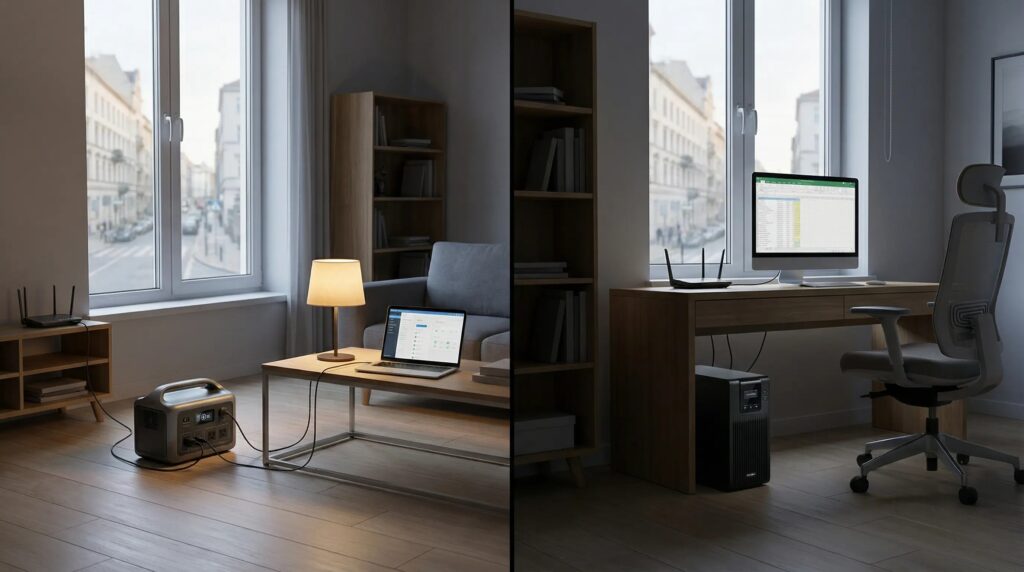
Portable Power Stations — Pros and Cons for Urban Living
When Portable Power Stations Make Sense
Portable power stations are particularly well-suited for apartment living. They operate quietly, require no ventilation, and can be stored easily when not in use. Their plug-and-play nature makes them ideal for people who want a simple and safe backup solution without permanent modifications.
They also offer flexibility. You can move them between rooms, charge them from standard outlets, and use them for multiple devices during outages.
Limitations You Should Know
Despite their advantages, portable power stations are not designed to power an entire home indefinitely. High-wattage appliances, long outages, or whole-house needs may exceed their capacity. Understanding these limits is key to avoiding unrealistic expectations.
UPS Systems — Best Use Cases (and Where They Fail)
UPS systems excel at one thing: protecting sensitive electronics from sudden shutdowns. They are excellent for maintaining internet access briefly, keeping a computer running during short outages, or preventing data loss.
However, many people mistakenly assume a UPS can serve as a full backup power system. In reality, most UPS units provide power for minutes—not hours—and are not designed to run household devices.
Solar Kits — Powerful but Often Impractical for Apartments
Solar backup systems shine in homes with rooftop access and long-term power needs. They can provide extended backup power and reduce grid dependence.
For apartment residents, however, installation challenges, legal restrictions, and limited sunlight access often make solar solutions impractica
Comparison Summary — Which One Fits Your Situation?
- If you live in an apartment with noise restrictions → portable power stations
- If you only need internet and computer backup → UPS
- If outages are frequent and long-term and you own your home → solar kits
- If you want safe, indoor, flexible power → portable power stations
How to Choose the Right Backup Power Solution for Your Home
Before choosing any backup power system, ask yourself:
- How long do outages typically last?
- Which devices are truly essential?
- Do you live in an apartment or a standalone home?
- Are noise and safety restrictions a concern?
Understanding basic household electricity safety and power usage is essential before choosing any backup system.
Final Thoughts
There is no universal backup power solution that fits every home. The right choice depends on how you live, where you live, and what you need to power during an outage.
In the next guides, we’ll break down specific backup power options for apartments, focusing on practical, quiet, and safe solutions designed for real urban living.