
How much power does an apartment need during a blackout?
Power outages can turn apartment living into a challenge within minutes. Internet access drops, lights go out, refrigerators stop running, and essential devices quickly lose power. Unlike houses, apartments come with unique limitations—restricted space, noise rules, and safety constraints—which make choosing the right backup power solution more complex.
One of the most common mistakes apartment residents make during blackouts is either underestimating or overestimating their real power needs. Buying too little power leads to frustration and downtime, while buying far more capacity than necessary often results in wasted money and unused equipment.
In this guide, we’ll break down exactly how much power an apartment realistically needs during a blackout. You’ll learn how to identify essential devices, calculate wattage and runtime, and match your real-world needs to the right type of backup power—so you can stay connected, safe, and prepared without overspending.
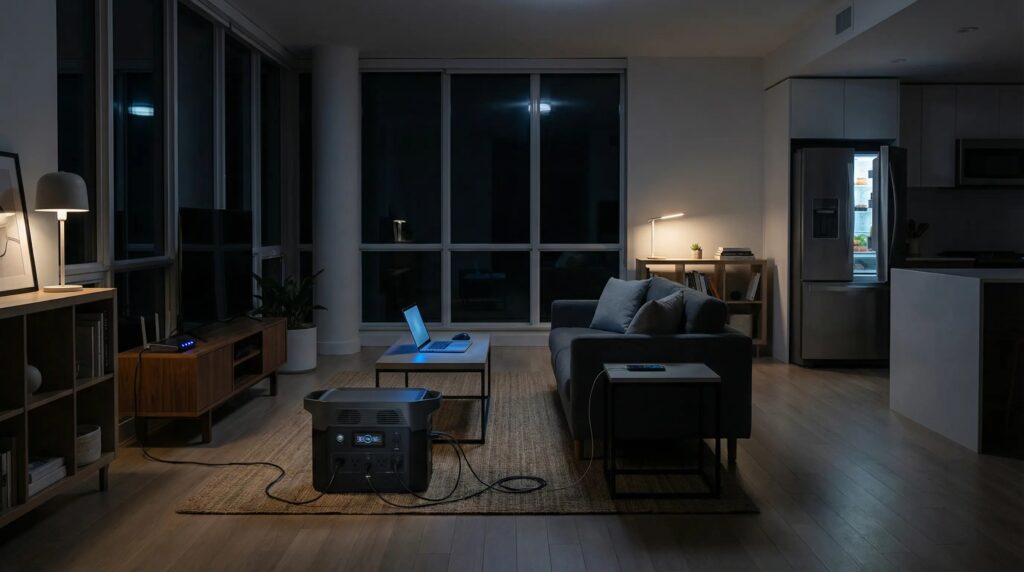
Understanding how much power does an apartment need during a blackout helps residents plan realistic backup solutions without overspending.
Why Knowing Your Apartment Power Needs Matters
Understanding how much power your apartment actually needs during a blackout is the foundation of any reliable backup power plan. Without this clarity, it’s easy to make decisions that either leave you unprepared or cause you to overspend on capacity you’ll never use.
In apartments, power limitations are more pronounced than in houses. Space constraints, indoor safety requirements, and building regulations mean you can’t rely on large generators or permanent installations. This makes accurate power planning even more critical, because every watt of capacity must be used efficiently.
When power needs are underestimated, essential devices such as internet routers, phones, and lighting may shut down sooner than expected, disrupting work, communication, and basic comfort. On the other hand, overestimating power requirements often leads to buying oversized systems that take up valuable space, cost significantly more, and offer little practical benefit for typical apartment outages.
Knowing your real power needs also helps you prepare for different outage scenarios. Short blackouts, overnight outages, and multi-day disruptions all demand different levels of power planning. By understanding what your apartment truly requires, you can choose a backup power approach that balances reliability, safety, and cost—without relying on guesswork.
Essential Devices to Power During an Apartment Blackout
When planning backup power for an apartment, the goal is not to power everything, but to keep the most important devices running. Focusing on essential loads helps you conserve energy, extend runtime, and choose a backup solution that matches real needs rather than ideal scenarios.
Below are the core device categories most apartment residents should prioritize during a blackout.
Internet & Communication
For many apartment residents, internet access and communication are the first priorities during a power outage.For specific steps on how to keep Wi-Fi running during power outages in an apartment, see our dedicated guide.
Wi-Fi routers, modems, and phone chargers consume relatively little power but play a critical role in staying connected, informed, and productive.
Keeping your router and a few charging devices powered allows you to access emergency updates, work remotely, contact family members, and use mobile devices without interruption. Because these devices draw low wattage, they offer a high value-to-power ratio and should always be included in an apartment backup plan.
Lighting
Lighting is another essential category that directly affects safety and comfort during a blackout. Even a small amount of light can make an apartment usable at night and reduce the risk of accidents.
LED lights are especially efficient and consume very little power compared to traditional bulbs. Powering a few lamps or LED light sources allows you to move safely through your apartment, prepare food, and maintain a sense of normalcy during outages without draining your backup power quickly.
Food & Refrigeration
Refrigeration becomes important when outages last longer than a couple of hours. A refrigerator helps preserve food, prevent waste, and maintain basic hygiene. However, refrigerators draw significantly more power than communication or lighting devices.
In apartment settings, refrigeration is often treated as a conditional priority. Some residents choose to power it intermittently rather than continuously, while others may prioritize it only during extended outages. Understanding how long food can safely remain cold helps determine whether refrigeration should be included in your backup power plan.
Medical & Work Devices
For certain apartment residents, medical or work-related devices are non-negotiable. Equipment such as CPAP machines, oxygen concentrators, or powered medical monitors must remain operational for health and safety reasons.
Similarly, work devices like laptops, monitors, and networking equipment are essential for remote workers. These devices typically consume moderate power and can often be supported efficiently with the right planning. Identifying these critical devices in advance ensures your backup power system supports what matters most when the grid goes down.
How to Calculate Power Needs for an Apartment
Calculating your apartment’s power needs doesn’t require technical expertise, but it does require understanding a few basic concepts. Once these are clear, estimating how much backup power you actually need becomes straightforward and far more accurate.
Understanding Watts vs Watt-Hours
Watts (W) measure how much power a device uses at a specific moment, while watt-hours (Wh) measure how much energy it consumes over time. This distinction is critical when planning backup power for an apartment.
For example, a Wi-Fi router might use 10–15 watts while operating. If it runs continuously for 10 hours during a blackout, the total energy required would be roughly 100–150 watt-hours. Backup power systems are rated primarily in watt-hours, which tells you how long they can support your devices—not just how powerful they are.
Many apartment residents focus only on wattage and overlook runtime. This leads to systems that can power devices briefly but fail during longer outages. Understanding watt-hours allows you to match battery capacity to real-world usage rather than peak power alone.
Estimating Runtime During an Outage
To estimate runtime, start by listing the essential devices you plan to power and their approximate wattage. Then multiply each device’s wattage by the number of hours you expect it to run during a blackout.
For example, if your essentials include a router, a laptop, and LED lighting, you can estimate their combined energy use over a typical outage window. This approach helps you determine whether you need backup power for a few hours, overnight, or longer.
It’s also important to account for usage patterns. Devices are rarely used at full capacity continuously. Laptops may be used intermittently, lights may only be needed at night, and refrigerators can be cycled on and off. Planning with realistic usage assumptions prevents overestimating power needs and improves overall efficiency.
By calculating power needs this way, apartment residents can select backup solutions that provide sufficient runtime without paying for unnecessary capacity or compromising indoor safety.
Typical Apartment Power Scenarios
Not all blackouts are the same, and apartment power planning should reflect realistic outage durations. Understanding how power needs change based on outage length helps you prepare without overspending or underestimating requirements.
Short Blackouts (1–3 hours)
Short blackouts are the most common type of power interruption in urban areas. These outages often occur due to brief grid issues, maintenance work, or localized overloads. While short, they can still disrupt daily life if essential devices lose power immediately.
During a short blackout, most apartment residents only need to keep low-power essentials running. Internet connectivity, phone charging, basic lighting, and laptop use are usually sufficient to maintain productivity and communication. Refrigeration is typically not critical during this time frame, as food can remain cold for several hours without power if the door stays closed.
Because power demand is limited, short outages require relatively small amounts of energy. Planning for this scenario helps avoid purchasing oversized systems when most interruptions last only a few hours.
Medium Outages (6–12 hours)
Medium-length outages often occur during severe weather events or wider grid disruptions. These outages extend beyond convenience and begin to affect comfort, food safety, and work routines.
In this scenario, apartment residents usually need to power communication devices, lighting during evening hours, work equipment, and possibly refrigeration for part of the outage. Power usage becomes more strategic, with devices cycled on and off to conserve energy and extend runtime.
Planning for medium outages requires a balance between capacity and efficiency. Residents who work remotely or rely heavily on internet access often prioritize stable connectivity, while others may focus on preserving food and maintaining basic living conditions overnight.
Extended Blackouts (24+ hours)
Extended blackouts are less frequent but have the greatest impact on apartment living. These outages may result from major storms, natural disasters, or large-scale infrastructure failures and can significantly disrupt daily routines.
During extended outages, power planning becomes more selective. Not all devices can be powered continuously, and priorities may shift based on safety, health, and essential communication. Refrigeration may be used intermittently, lighting conserved, and non-essential electronics kept offline.
For apartment residents, extended outages highlight the importance of realistic expectations. While full home power is rarely achievable in an apartment setting, understanding how to stretch limited energy resources helps maintain safety and functionality until grid power is restored.
According to the U.S. Department of Energy, understanding the energy usage of household appliances is essential when estimating how much power an apartment needs during a blackout.
Common Mistakes Apartment Residents Make
Even with good intentions, many apartment residents make avoidable mistakes when planning backup power for blackouts. These errors often lead to wasted money, reduced effectiveness, or systems that don’t perform as expected when power actually goes out.
Overestimating Power Capacity Needs
One of the most common mistakes is assuming that more power is always better. While having extra capacity may seem like a safe choice, oversized backup systems often take up valuable space, cost significantly more, and remain underused in real apartment scenarios.
Most apartments don’t require enough power to run multiple high-watt appliances simultaneously. Planning for realistic usage—rather than worst-case assumptions—results in a more practical, efficient, and affordable backup power setup.
Ignoring Critical Devices
Another frequent error is focusing on convenience devices while overlooking critical ones. Apartment residents may plan to power entertainment equipment or non-essential electronics, only to realize later that internet connectivity, communication devices, or medical equipment were not properly prioritized.
Identifying truly essential devices before choosing a backup power solution ensures that limited energy capacity is used where it matters most. This approach improves reliability during outages and reduces unnecessary strain on backup systems.
Relying on a Single Backup Solution
Many people rely on one backup power solution to cover every possible scenario. While this may work for short outages, it often falls short during longer or unpredictable disruptions.
Apartments benefit most from layered planning, where different tools serve different roles. Understanding the limitations of any single solution helps residents prepare more effectively without expecting one system to solve every problem.
Matching Power Needs to the Right Backup Solution
Once you understand your apartment’s real power needs, choosing the right backup solution becomes much clearer. The goal is not to find a single system that does everything, but to match each outage scenario and device priority with the most appropriate type of backup power.
For apartments, low to moderate power needs are the most common. In these cases, battery-based solutions are often the safest and most practical starting point. Systems designed for indoor use can support essential devices like routers, laptops, lighting, and selected appliances without noise or emissions.
If you’re evaluating which options work best specifically for apartment living, our guide to best portable power stations for apartments breaks down capacity ranges and real-world use cases in detail.
When instant power continuity is critical—such as for internet equipment, workstations, or medical devices—short-term backup solutions play an important role. These systems are designed to prevent sudden shutdowns rather than provide long runtimes. In many apartments, combining instant protection with extended backup coverage creates a more reliable overall setup.
For a deeper comparison of how these systems differ in real apartment scenarios, see our complete overview of backup power solutions for apartments, which explains where each option fits best.
Finally, understanding how long your apartment typically loses power helps determine whether a single solution is sufficient or whether a layered approach is more effective. Short outages may only require minimal capacity, while longer disruptions benefit from flexible systems that can stretch limited energy efficiently.
Matching power needs to the right solution ensures you stay prepared without overspending, overloading equipment, or relying on setups that aren’t suited for apartment constraints.
Final Takeaway: Power Planning Before You Buy
Power outages don’t affect every apartment the same way, which is why understanding your real power needs is more important than buying the biggest or most expensive backup system available. By identifying essential devices, estimating realistic runtimes, and planning for different outage scenarios, apartment residents can make smarter and more efficient backup power decisions.
Taking the time to calculate power requirements before choosing a solution helps avoid common mistakes such as overspending, under-preparing, or relying on setups that don’t match apartment living constraints. A well-planned approach ensures that when a blackout happens, you stay connected, safe, and prepared—without unnecessary complexity.
Knowing how much power does an apartment need during a blackout allows you to prepare for outages efficiently while focusing on essential devices only.